Monday, April 8, 2013

#1 Late Night Talkshows?


“THE Daily Show WITH JON STEWART” AND “THE Colbert Report

TOP THE COMPETITION DURING 1Q 2013

AS THE MOST-WATCHED LATE NIGHT TALK SHOWS AMONG ADULTS 18-49,

ADULTS 18-34, ADULTS 18-24, ADULTS 25-34, MEN 18-49, MEN 18-34 AND MEN 18-24

--------

“The Daily Show” Earns Its 8th Consecutive Quarter as the #1 Late Night Talk Show among Adults 18-49

--------

“The Colbert Report” Surpasses “The Tonight Show with Jay Leno” for First Time in Key 18-49 Demo

--------

TheDailyShow.com and ColbertNation.com Top All Late Night Talk Show Sites

Among Total Visits, Unique Visitors, Total Minutes/Time Spent and Videos Streamed

--------

“The Daily Show” and “The Colbert Report” Tops Among All Late Night Talks Shows on Facebook

--------

NEW YORK, April 4, 2013 – They’re all fighting for third place now. For the first time, “The Colbert Report” has overtaken “The Tonight Show with Jay Leno” among Adults 18-49 for a full quarter to give COMEDY CENTRAL the #1 and #2 late night talk shows in the key advertiser demographic, joining “The Daily Show with Jon Stewart” at the top of the ratings charts. The multiple Emmy® and Peabody® Award-winning series also continued their long-standing dominance among younger viewers finishing the quarter as the most-watched late night talks shows in all of television, both broadcast and cable, among Adults 18-34, Adults 18-24, Adults 25-34, Men 18-49, Men 18-34 and Men 18-24. TheDailyShow.com and ColbertNation.com maintained their industry-leading positions as the top late night talk shows in digital during 1Q 2013 leading the field among Total Visits, Unique Visitors, Total Minutes/Time Spent and Videos Streamed. (source: Nielsen Media Research, most current data, original episodes only, 12/31/12-3/31/13; comScore MediaMetrix, 1/1/13-2/28/13)

For the first quarter of 2013, “The Daily Show” averaged 2.5 million total viewers and a 1.3 Adults 18-49 rating (1.4 million Adult 18-49 viewers). The series exhibited especially strong growth among younger viewers with ratings up +21% among Adults 18-24 and +18% among Men 18-24 versus 1Q 2012. “The Daily Show” was the most-watched late night talk show among Adults 18-49, Adults 18-34, Adults 18-24, Adults 25-34, Men 18-49, Men 18-34, Men 18-24 and during 1Q 2013.

(more)


In surpassing the last broadcast hurdle among Adults 18-49, “The Colbert Report” averaged an audience of 1.9 million total viewers and a 1.0 Adults 18-49 rating (1.1 million Adult 18-49 viewers). Like its lead-in, “The Colbert Report” showed strong growth among younger viewers with ratings up +12% among Men 18-34 and +16% among Men 18-24 versus 1Q 2012. “The Colbert Report” was the second most-watched late night talk show among Adults 18-49, Adults 18-34, Adults 18-24, Adults 25-34, Men 18-49, Men 18-34, Men 18-24 and during 1Q 2013, finishing behind only “The Daily Show” in each of the demos.

On the digital front, TheDailyShow.com and ColbertNation.com were the top two sites among late night talk shows during 1Q 2013 to-date in Total Visits, Unique Visitors, Total Minutes/Time Spent and Videos Streamed and both shows dominate social media with more Facebook fans than any other late night talk show. TheDailyShow.com dominates the field with an average of 1.5 million Unique Visitors and 21 million minutes spent on the site per month - more than five times the amount of time spent on third-place TeamCoco.com and more than double the combined total time spent on show sites for “Conan,” “The Tonight Show with Jay Leno,” “The Late Show with David Letterman,” “Late Night with Jimmy Fallon” and “Jimmy Kimmel Live.” There were also four times more videos streamed on TheDailyShow.com than all other late night talk show competitors sites combined (excluding “The Colbert Report”).

Jon Stewart and Rory Albanese are the Executive Producers of “The Daily Show with Jon Stewart” with Steve Bodow, Jennifer Flanz and Adam Lowitt serving as Co-Executive Producers. Supervising Producers are Tim Carvell, Pam DePace, Tim Greenberg, Hillary Kun and Stuart Miller. Jill Katz is Producer and Executive in Charge of Production. Kahane Cooperman serves as Production Executive. The series' Head Writer is Carvell and it is directed by CHUCK O'Neil.

“The Daily Show” airs Monday-Thursday at 11:00 p.m. and repeats at 1:00 a.m. the same night and at 9:00 a.m., and 7:30 p.m. the following day (all times ET/PT). Full episodes, as well as clips, are posted for viewing the following day at www.thedailyshow.com with URL and embed links. Fans can follow @TheDailyShow on Twitter or “like” “The Daily Show” on Facebook (3.7 million fans).

“The Colbert Report” is produced by Jon Stewart’s Busboy Productions, Inc. in association with Colbert’s Spartina Productions, Inc. Stewart, Colbert and Tom Purcell are the Executive Producers with Meredith Bennett, Richard Dahm and Barry Julien as Co-Executive Producers. The series’ Head Writer is Opus Moreschi and it is directed by Jim Hoskinson.

“The Colbert Report” airs Monday-Thursday at 11:30 p.m. and repeats at 1:30 a.m. the same night and at 9:30 a.m., and 7:00 p.m. the following day (all times ET/PT). Full episodes, as well as clips, are posted for viewing the following day at www.colbertnation.com with URL and embed links. Fans can follow Colbert’s Twitter feed @StephenAtHome (4.7 million followers) and “like” “The Colbert Report” on Facebook (2.8 million fans).

Saturday, April 6, 2013

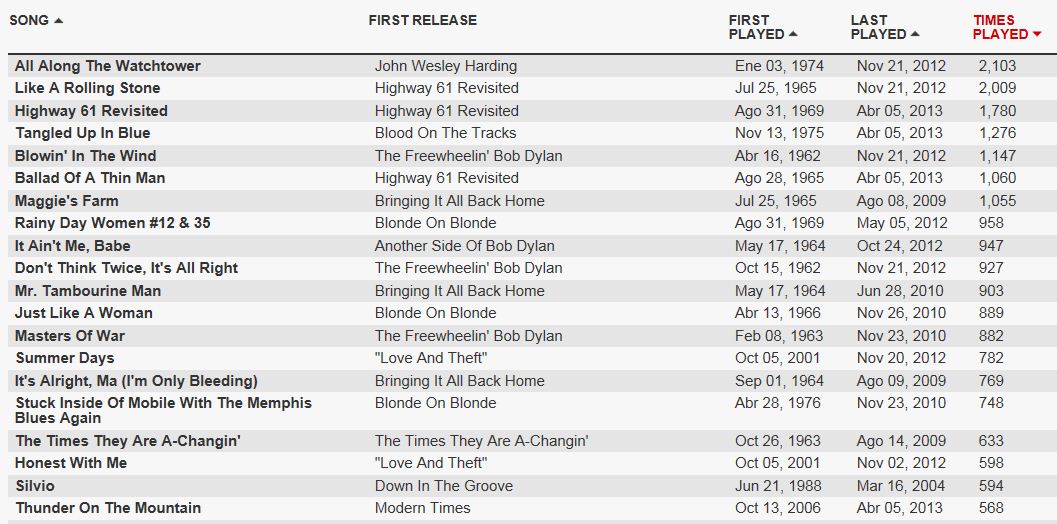
Top 20 songs Bob Dylan has performed in concert:

Excerpt from: BobDylan.com
 
Top 20 songs Bob Dylan has performed in concert:

[I have personally seen Maggie's Farm performed quite a number of times. :)  Somewhere in 2009 he must have gotten tired of it. :) ]

Thursday, April 4, 2013

Vintage Paperbacks: excerpt from: Good Girl Art.com

Excerpt from: http://goodgirlart.com


There were two ways to show naked ladies on paperback covers; one was to make her some kind of exotic, foreign native or, have her be an artists' model. Just the term alone conjures up nudity. While still not showing 'everything', they could go further than others, for example, see the nice Berkley Books cover on the left. The other trick was to show the model, say from the back, and then the work of 'art' from the front. Paintings in paintings didn't count.


Another nice Berkley cover, this one by Robert Maguire. Here is the most common and typical artist cover with him looking at her front and the rest of us at the back. This is where imagination comes in.
This is the perfect example of showing the 'piece of art' as the nude, and full frontal nudity at that (well, almost). This was on par with the air brushed nudes in artist's magazines at the time.
A homerun!! All three bases. The GGA girl, the nude model and the nude painting all done by Rudolph Belarski. Popular Library covers were never crude but they did manage to unbutton 2 or 3 buttons.
Here is the mirror again, like in the turn of the Century (19th) French Postcards we've seen before. He's not looking at the mirror and neither is she, so it must be there for you and me.
While not exactly artists' models, what better place for an 'arty' cover. Dali would have been proud.

Comments on Netflix


One might think that I would like movies, which are fully contained units. Well, not so much. While it might seem like movies have the advantage in artistic freedom, there really is a set format that is limited by time. A movie can only be so long and all parts of the story have to fit. There is little time for character development, there is limited time for changing the plot to suit the actors, etc. It leads to predictability. One might think movies to be analogous to novels and television to short stories, but I find the opposite to be true. And Netflix, they understand this. The release of "House of Cards" as a complete unit rather than a nightly series was right on target. A "work" had been presented. I notice that British television often has contained units of 3 parts or 5 parts, or really any number of parts, for many shows. This is sort of like the demised American miniseries. And it works. Netflix understands this too and has a number of these types of shows in their lineup. I think viewers like shows with endings and viewers like shows with long story archs. I myself like to be enveloped by a story for long periods of time. I like familiar faces. And I would rather watch a rerun of a good series than watch one from the beginning not knowing if it will fail or succeed. Broadcast networks need to know that their type of disrespect for the viewer will eventually be their undoing. I don't trust them with new shows, do you?]


Title: Netflix Introduces 'Sense8'

Source: Entertainment Close-up. (Apr. 2, 2013):
Netflix announced it will bring Georgeville Television's Sense8, a global tale of minds linked and souls hunted, exclusively to its members to watch instantly in late 2014.
According to a release, the 10 episode season one of Sense8 marks a foray into television by the Wachowskis, the creative geniuses behind Bound, The Matrix, The Matrix Reloaded, The Matrix Revolutions, V for Vendetta, Speed Racer and Cloud Atlas, and is the latest project from veteran show runner J. Michael Straczynski, creator of the Babylon 5 TV series and whose film credits include Changeling, Thor and Underworld Awakening,
"Andy and Lana Wachowski and Joe Straczynski are among the most imaginative writers and gifted visual storytellers of our time," said Netflix chief content officer Ted Sarandos. "Their incredible creations are favorites of Netflix members globally and we can't wait to bring Sense8 to life."
"We're excited to work with Netflix and Georgeville Television on this project, and we've wanted to work with Joe Straczynski for years, chiefly due to the fact his name is harder to pronounce than ours, but also because we share a love of genre and all things nerdy," said Andy and Lana Wachowski. "Several years ago, we had a late night conversation about the ways technology simultaneously unites and divides us, and out of that paradox Sense8 was born."
"We are proud to be working with Netflix on this new series," said Straczynski. "Lana, Andy, and I are fans of each other's creations, and have been looking for something to do together for nearly a decade."
Netflix said Sense8 is being produced by Georgeville Television, in association with Studio JMS. Georgeville Television is a Reliance Entertainment company and independent television studio, formed by veteran film and television producer Marc Rosen, in partnership by Motion Picture Capital's Leon Clarance and Producer Deepak Nayar. Formed in 2012, Georgeville Television currently has two series in pre-production, including NBC's Crossbones starring John Malkovich. Rosen, Clarance, and Nayar will serve as executive producers on Sense8.
Studio JMS, launched last year by Straczynski and CEO Patricia Tallman, was founded to produce a range of film, television, comics and other media properties. In addition to The Flickering Light, Straczynski's feature directorial debut, and Sense8, Studio JMS has created a new comics imprint, Joe's Comics, published in partnership with Image Comics. Its first series, "Ten Grand," will debut in May. In addition to Sense8, Motion Picture Capital is producing The Flickering Light, which begins filming in Berlin later this year.
"Sense8 is a dream-come-true creatively, and we look forward to working closely with our new partners at Netflix, with whom we could not be more excited to bring the Wachowski's first TV series ever to life," said Rosen.
"We're delighted to once again partner with Joe, and have the opportunity to work with Lana and Andy, two of our movie-making heroes, on their television debut," said Clarance. "They have created a brilliant concept, which will be a wonderful story to produce, and a rich conceptual world for viewers to experience."
Netflix is an Internet television network.

Wednesday, April 3, 2013

"...there may be no harsher world for women to make headway in than Wall Street"

The Washington Women Who Leaned In When Sheryl Sandberg Didn't

Michael Hirsh

Source: Nationaljournal.com  (Mar. 12, 2013)
 
While debate rages outside the Beltway over Sheryl Sandberg's advice for fixing a male-dominated world, here in Washington, a handful of powerful women have been "leaning" way ahead of her in taking on what may be the most chauvinistic industry in America: Wall Street. (And, in a few cases, they've done it while raising families at the same time.)
 
They may not be getting quite as much air time -- or publicity -- as Facebook's Sandberg, whose book, Lean In: Women, Work and the Will to Lead, is now topping Amazon's best-seller list. But they may have a few things to teach her. It's a striking theme in finance that goes back to well before the crisis of 2008: Very often the gutsiest and most prescient adversaries of Wall Street have been women, many of them tough regulators who looked over their shoulders and found scant few male supporters when it came to confronting the (typically all male) titans of finance and economics. Among them: new Sen. Elizabeth Warren, D-Mass.; former Obama economic adviser Christina Romer; retired bank regulator Sheila Bair; and Brooksley Born, who as a far-sighted derivatives overseer in the late '90s took on the powerful Robert Rubin cabal and, for her troubles, was railroaded out of government.
 
A new member of this distinctive club is now expected: Mary Jo White, who will shortly be confirmed as the new head of the Securities and Exchange Commission. Despite questions about White's potential conflicts of interest -- she has occasionally represented Wall Streeters -- no one doubts her toughness and willingness to confront aggressive men: During her nine-year stint as U.S. attorney for the Southern District of New York, the 5-foot-tall White won convictions of senior al-Qaida leaders and Mafiosi such as John Gotti. She has since promised "unrelenting" enforcement of Wall Street.
Setting aside Arab terrorist groups and the mob, there may be no harsher world for women to make headway in than Wall Street. Especially compared to the nerds of Silicon Valley, no corporate culture is more macho than Wall Street's, which is perhaps why its heaviest hitters used to be known by a part of their anatomy that women don't share.
 
Consider Warren, who almost immediately upon being sworn in as a new U.S. senator picked up where she had left off as the fiery Harvard Law professor who first came up with the idea for a financial consumer-protection agency. In a February hearing, Warren quickly took the "too-big-to-fail" debate to a new level, hammering a panel of stammering regulators over their failure to prosecute bank criminality. "There are district attorneys and United States attorneys out there every day squeezing ordinary citizens on sometimes very thin grounds and taking them to trial in order to 'make an example,' as they put it," Warren said. "I'm really concerned that 'too big to fail' has become 'too big for trial.' "
 
Romer, meanwhile, appeared to be the only one with the guts to tell Larry Summers -- in his second incarnation as a mistake-prone economic adviser, this time under Obama -- that the administration's first-term stimulus was too small. Working in a White House that author Ron Suskind described as a "boys' club," Romer wrote what one pundit, Business Insider's Joe Weisenthal (http://www.businessinsider.com/this-is-the-memo-that-could-have-saved-the-us-economy-2012-2?op=1), called "the Memo that Could Have Saved the U.S. Economy." She showed -- probably correctly -- that something on the order of a $1.8 trillion stimulus was needed but was squelched by Summers, who she said made her feel like "like a piece of meat" when he "boxed" her out, according to Suskind's Confidence Men: Wall Street, Washington, and the Education of a President.
 
And then there was Bair, who saw back in the early 2000s, when she was assistant Treasury secretary under Paul O'Neill, that the lending industry and a securitization-mad Wall Street were out of control. Bair sought to impose "best practices" on the lending industry, including rules that would require documentation of a borrower's ability to repay; and limiting refinancing to prevent loan flipping. She failed and, after a hiatus to raise her children in Massachusetts, came roaring back as the head of the Federal Deposit Insurance Corp., becoming the principal challenger to the often excessively cautious decisions of Treasury Secretary Tim Geithner on housing and regulation. In her strikingly blunt new memoir, Bull by the Horns, Bair wrote of Geithner: "I couldn't think of one Dodd-Frank reform that Tim strongly supported. Resolution authority, derivatives reform, the Volcker and Collins amendments -- he had worked to weaken or oppose them all."
 
Bair, a Republican from Kansas, had something common with another tough female regulator, Born, who happened to be a liberal Democrat (sexism apparently knows no politics). Both ran up against the same problem: accusations from the men in charge that they weren't "team players." In Bair's case, Geithner's Treasury Department was accused of leaking that story; when it came to Born, she found herself taking on the powerful team of Rubin and then-Federal Reserve Chairman Alan Greenspan, as well as most of Congress (at one point she was forced to leave the hospital while her daughter was in the operating room when she was called up to testify).
 
Born, the head of the Commodity Futures Trading Commission, was eventually pressured to step down. But much later on, one of the men who had pilloried her, Arthur Levitt, the chairman of the Securities and Exchange Commission during the Clinton years, became one of the few men to publicly vindicate her for warnings about the vast over-the-counter derivatives market that was about to help melt down the financial system. "All tragedies in life are always proceeded by warnings," he told me. "We had a warning. It was Brooksley Born. We didn't listen to that."
 
So pay attention, Sheryl: You've got some serious role models here. Of course, it may be that the life lessons of some of these women could bring back uncomfortable memories for you. As my colleague Matt Cooper pointed out yesterday (http://www.nationaljournal.com/politics/two-cheers-for-sheryl-sandberg-who-helped-give-us-the-financial-crisis-201), Sandberg herself did precious little "leaning in" in the late '90s while serving as chief of staff to then-Treasury Secretary Summers, when he helped hand Wall Street license to wreak disaster on the American economy.

Tuesday, April 2, 2013

Heart of Darkness

[I heard a report on World Have Your Say on BBC News on my way to work this morning. I heard a segment from John Sweeney about his visit to North Korea. He calls the North Korean government the worst in the world. Basically he talked for quite some time trying to come up with superlatives to describe how frighteningly irresponsible the government and how desparately out of touch and impoverished the citizens are. He attempted to show the rediculous nature of opulent wealth vs. extreme poverty. Kissing the British soil when he got home was just one of the stretches of imagination he used to share just how bad the things he discovered on his trip were. I will look to see if I can get a transcript of that. I doubt it. But I will post here this article that was interesting. In America we are caught up by silly politics that makes one gasp at the irresponsibility, but we are far from as bad as it gets. John Sweeney's account reminded me a bit of a Marlow narrative from Conrad's Heart of Darkness]
 
How potent are North Korea's threats?
North Korea missile ranges map
Since the latest UN sanctions, North Korea has unleashed a salvo of threats against the US and South Korea, even vowing to restart operations at its main nuclear complex. The BBC examines how much of a threat North Korea really poses to the US and its Asian neighbours.

North Korea's threats

North Korea has frequently employed bellicose rhetoric towards its perceived aggressors.
The 1994 threat by a North Korean negotiator to turn Seoul into "a sea of fire" prompted South Koreans to stock up on essentials in panic.

"When you look at occasions where something really did happen, such as the artillery attack on a South Korean island in 2010, you see there were very clear warnings” Professor John Delury, Yonsei university

After US President George W Bush labelled it part of the "axis of evil" in 2002, Pyongyang said it would "mercilessly wipe out the aggressors".
Last June the army warned that artillery was aimed at seven South Korean media groups and threatened a "merciless sacred war".
There is also a pattern of escalating threats whenever South Korea gets a new leader.
While many observers dismiss the rhetoric as bluster, others warn of "the tyranny of low expectations" when it comes to understanding North Korea, because there have been a number of serious regional confrontations.
North Korea expert Aidan Foster-Carter says the rhetoric from the North is all too familiar.
"If you follow North Korean media you constantly see bellicose language directed against the US and South Korea and occasionally Japan is thrown in there, and it's hard to know what to take seriously. But then when you look at occasions where something really did happen, such as the artillery attack on a South Korean island in 2010, you see there were very clear warnings," Professor John Delury at South Korea's Yonsei university told the BBC.
The North consistently warned that military exercises being conducted in the area would spark a retaliation.
Mr Delury argues that misreading Pyongyang's intentions and misunderstanding its capabilities has kept the US and South Korea stuck in a North Korean quagmire.

Picking apart the bluster

The latest warning of a pre-emptive nuclear attack was in response to joint military exercises between South Korea and the US rather than sanctions per se.
"Any time a nation threatens pre-emptive nuclear war, there is cause for concern. North Korea is no exception, with its recent shift in rhetoric from accusing the US of imagining a North Korean ballistic missile threat, to vowing to use its ballistic missile capabilities to strike the continental US," says Andrea Berger, from the Royal United Services Institute in London.
North Korean leader Kim Jong Il, left, toasts U.S. Secretary of State Madeleine Albright at a dinner in Pyongyang on Tuesday October 24, 2000. Former leader Kim Jong-il in friendlier times between the US and North Korea
But many experts believe these threats come from the North's desire for a peace treaty with the US.
"It seems to believe that it will not be taken seriously until it can enter talks on this issue with sizeable military strength. This is in line with Pyongyang's historic military-first policy," Ms Berger says.
The US is often centre-stage. "There are cases where the threats are geared towards getting on the radar particularly of the White House, which tries to ignore North Korea as a matter of policy. Pyongyang's message is - you cannot break us, we will not go away, you have to deal with us," Mr Delury said.
The latest series of threats are being seen as "bluff" because the North's leaders know a nuclear attack would be suicidal and impractical, given the North's rudimentary missile programme.
And many point out that it is unclear exactly which pacts North Korea has abandoned as some were never properly implemented. And the North has also threatened to scrap the armistice agreement before this - there are several well documented attempts.
But the North may yet respond to sanctions by provoking a conventional forces border clash with South Korea, either on land or sea, as it has done before.
It has now said it will restart operations at its main nuclear facility at Yongbyon - this could open up a new source of plutonium for the North's weapons programme.
When it comes to enriching uranium, it is unclear how many secret plants already exist and there is still no clear evidence to indicate whether the North's latest nuclear test was uranium-based. Nevertheless, experts say facilities at Yongbyon could be converted to produce weapons-grade uranium.

Is the US a real target?

South Korean tests carried out on fragments of a rocket fired in December in what the North describes as a satellite launch showed it would have had a range of more than 10,000km (6,200 miles), putting the US well within striking distance.
However, there is little evidence that North Korea has yet developed a guidance system to ensure an accurate strike, or the re-entry technology to bring an intercontinental ballistic missile (IBM) back down.
This file photo taken on April 8, 2012 shows two North Korean soldiers standing guard in front of the Unha-3 rocket at Tangachai -ri space center North Korea successfully launched a rocket in December
Pyongyang's ability to carry out a nuclear strike on the US is even less certain, as analysts do not believe it has yet managed to create a small enough nuclear device to be mounted on a warhead.
December's missile launch, the International Institute for Strategic Studies said, proved that North Korea has something that can hit American shores but it says that any "functioning nuclear-tipped intercontinental ballistic missile is still at least several years away".
North Korea has shown it is determined to pursue this technology. Its latest underground nuclear test was double the size of the previous one in 2009.
The North claimed that a nuclear test in February detonated "an atomic warhead that is lighter and miniaturised but with a big explosive charge".
nuclear graphic
But while the North might struggle to hit the US, it could target US interests in the region. There are more than 28,000 US military personnel based in South Korea, another 40,000 in Japan and a large military base in Guam, a US territory off the Philippines.
The US is also obliged to defend Japan if it is attacked under the terms of the post-World War II security alliance between Washington and Tokyo.
Even if a missile is launched from the North, Washington has insisted it is "fully capable" of blocking any attack against it or its allies.
It is also worth noting that the only US Navy ship being held by a foreign power is in Pyongyang.
The USS Pueblo was captured while on a surveillance mission in 1968. It was in international waters during its mission and nobody imagined that the North Koreans might capture it - so the crew were unprepared.
One crew member died and 82 were taken to North Korean prison camps, where they were held for 11 months, accused of spying. They were released once the US apologised and insisted the ship had not been spying - later retracting both statements.

North Korea's neighbours

"The Cheonan sank close to the disputed sea boundary between North and South Korean territorial waters, along which the two navies have clashed a number of times in the past decade”

Since the Korean War ended, Pyongyang has repeatedly shown its ability to strike neighbours and foreign interests in the region, often in response to what it sees a provocation.
In 1967, it attacked and sank South Korea's vessel the Dangpo as it patrolled in the Yellow Sea, killing 39 of the crew.
There followed a period of relative calm - though sabre-rattling continued - as South Korea pursued its "Sunshine Policy", an attempt to steadily build closer relations and reduce tensions between 1998 and 2008.
But in March 2010, the South Korean warship Cheonan travelling close to the disputed maritime border - known as the Northern Limit Line (NLL) - was split in half by an explosion, leaving 46 sailors dead. South Korea said the only "plausible explanation" was that it had been hit by a North Korean torpedo. Pyongyang denied this.
Wreckage of the Cheonan, on 19 May 2010 Teams have salvaged the wreckage of the Cheonan from the sea bed
In November that year, North Korean troops launched an artillery strike on South Korea's Yeonpyeong Island, just south of the NLL. Two South Korean marines and two civilians were killed. Pyongyang said the clash was provoked by a South Korean military drill being conducted near the island.
North Korea has a conventional army of more than 1.1m, but its equipment is thought to be Soviet-era and in poor condition.
However it still has a vast amount of artillery lined up along the demilitarised zone, and the South Korean capital Seoul is within its reach.
According to the International Institute for Strategic Studies' military balance, approximately 65% of North Korea's military units, and up to 80% of its estimated aggregate firepower are within 100km of the DMZ.

Friday, March 29, 2013

The Chromebook Isn't Bad, Just Misunderstood

The announcement of the Chromebook Pixel has driven something home for me: People don't get the Chromebook--and by people, I mostly mean the tech journalists covering it. Reviewers and pundits have poo-pooed Google's Web-connected laptops almost since day one, harping on the devices for being too expensive, too limited, too reliant on the Web. In the meantime, Chromebooks have gotten astonishingly inexpensive, picked up all sorts of functionality, and greatly expanded that functionality online and off.

The Chromebook is a category unto itself, distinct from regular laptops. And the features championed by Google's Chromebook experiment are already sending ripples through the tech world, with Microsoft's Office 365 offering an answer to Google Docs, and cloud storage services like SkyDrive and Dropbox gaining popularity. Chromebooks may not be for all users in all circumstances, but they still have a place in the market, and are rapidly evolving beyond the devices that formed the basis of many reviewers' first impressions. Shouldn't those opinions be evolving as well?

The Hardware/Software Focus

The dominant paradigm in the PC market is all about hardware and software--your ability to do and create has long been limited by processor speed, storage space, and the programs that utilize them. It's not an incorrect way to view the world, and for many, it's still the way things are. But the years spent focusing on speeds and feeds--the numbers we use to compare components and products--have left many unable to recognize the Chromebook for what it is: a device coming from a completely different place.

Google approaches personal technology differently, starting and finishing with the Web. Some of this is self-serving--the more time people spend online, the more often Google can serve them ads. But the simple fact is that, when it comes to life online, the folks at Google know their stuff as well as--if not better than--anyone else.

From Google's Web-centric point of view, this hardware-myopia isn't serving people well at an individual level. For many people, laptops are mainly used to connect with other people, find and share information, and to do the occasional productive task--and Google knows that you don't need expensive hardware and sophisticated software to do any of that. All you really need is an Internet connection.

For folks who write papers, manage their finances, and edit photos, Google already has free tools available online, namely Google Docs and Picasa, that offer the basic features of Word, Excel, and Photoshop. Do these services duplicate every feature? No. But it can be argued that most people don't need them. So why pay for them?

Limitations and Features

Plenty has been written about the limitations of the Chromebook. The local storage is small. Processing power is skimpy--the Acer C7 Chromebook (C710-2847) uses a dual-core Celeron processor, while the Samsung Chromebook Series 3 (XE303C12) uses an Intel Atom processor. Neither are powerhouse CPUs. There's also no support for the software you're accustomed to using. No Microsoft Office, no Photoshop, no nothing. You're limited to whatever Web-based apps and services you can find. To top it all off, Chrome is mostly just a browser, and requires an Internet connection. But there's a problem with this list of limitations--it's comparing apples to oranges, then declaring the apple deficient for lacking the most basic features of good citrus fruit.

Local storage is small, but that's hardly relevant--not when you're storing your data in the cloud. Instead, the cloud offers storage that can also be accessed at any time, from your PC, tablet, or smartphone. When you replace your Chromebook for another, data migration isn't an issue, because there's nothing to migrate. You already have access to everything you need.

When you don't have anything taxing to run, or you can shift that workload to more powerful resources elsewhere, then the size and speed of your CPU isn't an issue. The hardware inside a Chromebook is only as important as the Web browsing it supports.

Complaints about software are moot. Of course it doesn't support software, you can't even install it. Your tool set is online, harnessing the hundreds of apps and extensions available for Chrome, for a fraction of the price, if not for free. And though you need be online to set it up, a large percentage of these tools also offer offline functionality, syncing automatically once you're connected again.

And let's not pretend that connectivity isn't an issue on any other machine. While you may have access to software and programs when your connection is severed, you won't have access to the myriad sites and services that you likely use the majority of your day. Goodbye email, instant messenger, and social media. So long Twitter, and Facebook, and YouTube, and Netflix, and Pandora, and Wikipedia, and anything else you rely on for productivity and procrastination. Let's be honest. Without the Internet, most of what you do comes to a screeching halt, Chromebook or otherwise.

Dogging a product for doing exactly what it is meant to do suggests that the problem isn't with the product, but the reviewer. Complaints about the Chromebook--wimpy hardware, small storage space, and the need for constant connectivity--may be completely true, by certain measures, but they are based on a flawed understanding of what the Chromebook is and how it works.

Continue Reading: The Big Question>

The Big Question

While powerful PCs will still have a place in coming years--particularly in the workplace, where professional tasks warrant investing in higher-grade tools--I think the personal computing experience will be dramatically influenced by Google's vision. The Chromebook is the device for our always-connected tomorrow, but a lot of people already live in the browser; there is a market for the Chromebook today.

People look at the Chromebook and ask "Why would you buy a Chromebook when you can buy this Windows/Mac system and get so much more?" But they have the question backwards. The real question isn't "Why settle for less?" it's "Why pay so much more for things I don't need?"

Permit me to use an analogy. Few would argue that Netflix and Hulu are better than a cable subscription. Cable simply offers more content. But that doesn't mean that you need cable, or even that you should always opt for cable over online services.

In fact, plenty of people have done the opposite, opting to stick with free streaming on Hulu and cheap streaming on Netflix Instant. It's not necessarily because these options are "better" than you would get with cable, but that it may be all you need, and there's no good reason to pay more for channels you don't watch and shows you never want to see.

Does a Windows machine offer more capability than a Chromebook? Of course. And for a lot of people, that's reason enough to stick with what they know. But that doesn't make the Chromebook a bad option, or a foolish purchase. It makes it a decision that should be considered beforehand. It makes it a poor decision if it's not a good fit.

But where it is a good fit--and there are plenty of folks using expensive PCs almost exclusively for Web browsing--then tech journalists have a responsibility to know that, and understand that, and guide people accordingly.

For more, see PCMag's hands on with the Chromebook Pixel and the slideshow above.